
 |
 |
A Quick Guide to making Sausage at Home
Written & Collated by Richard Farish (AKA Sausagemaker)
INTRODUCTION
I could start by telling you that it is a fascinating hobby, but I won’t as you already know that.
So lets start with the equipment you are going to need, surprisingly very little is required to get you going & I would strongly suggest that you keep everything on the small side until you are sure you like the hobby.
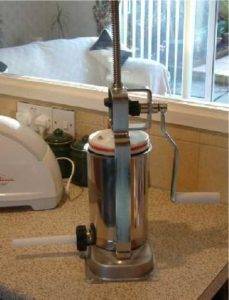
Standard mincer and filler
This is one of the best selling models for the beginner sausage maker.
It comes with 3 stuffing tubes, instructions and recipe guide and is simple to use, just feed the mincer cubes of chilled meat then take out the blade and feed the minced meat through into the stuffing tubes.
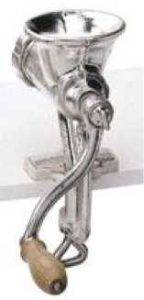
The next step from this would be an electric model with sausage making attachments, this is a lot less stressful & easier in the arms.
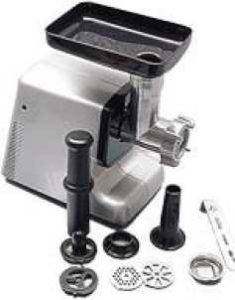
You can often find these for sale in the discounters for around £30 & well worth it.
Rusk & Fillers
Rusk is an essential ingredient in sausage making, used by all professional sausage makers and experienced home users alike. Use up to 10% rusk in your sausage to improve the texture and bite, it helps bind the fat within the sausage and helps retain moisture making a more succulent sausage.
Other fillers can be used I have often used breadcrumb, crushed cream crackers, Oatmeal Potato starch or even a mixture of them all.
Soak up rate will vary as a rule rusk is 2 parts water to 1 part rusk & breadcrumb is about 1.5 part water to 1 part bread.
As for the rest I would suggest 1 part water to 1 part filler.
Seasoning Mixes & Seasonings
Seasoning mixes are a good start until you are ready to mix your own, however a word of warning here, please make sure what you are using if it is a mix then the probability is that the rusk is already included & the usage will be around 12.5% -15%.
If it is a seasoning then the usage is more like 2.5%
Further on in this guide we will look at some seasoning recipes.
Casings
Hog casings are best to start with as they are easier to work with than the delicate sheep casings and produce a good thick sausage.
These casings should be soaked in water for at least 2 hours prior to using & then re washed to remove the salt.
These are supplied in salt. Use what you need and once resealed in a Ziploc type bag, casings can be stored for months in the fridge.
Collagen Casings are dry casing that do not need to be soaked before use and therefore are very good at storage, these are available in various sizes, however be careful as most sausage horns are tapered & the casing cannot be pushed on easily.
If you intend to use this type try & get a straight edged sausage horn.
How much casing to use will be dependant upon the diameter of the casing, I tend to use 28mm hog or collagen & will use about 3ft per lb, 18 – 20mm sheep casing or collagen use about 5ft per lb.
Other Equipment
Next we need to look at the other equipment you will require all of these can probably found in your kitchen.
Kitchen Scales,
Mixing bowls,
Knives and spoons.
Meats
Now that we have all the equipment we now need to look at what meats we are going to use, this will depend on the sausage that you are going to make.
Pork is the most popular and as luck would have it the least expensive at least here in the UK. Use Pork Shoulder, belly pork & pork fat although you can use any part of any animal you wish.
Beef do not use all beef in a sausage as it tends to end up like burger in a tube, use flank, shin, or cheap mince (This will have about 15-20% fat)
Lamb or Mutton is good for Middle Eastern type sausage
Chicken & Turkey are very good for low fat style sausage
Approximate Lean to Fat Ratio’s
|
Meat Cut |
Approximate Lean Meat % |
Approximate Fat % |
|
Pork Shoulder |
80 |
20 |
|
Pork Belly |
60 |
40 |
|
Pork Jowl |
50 |
50 |
|
Beef Flank |
75 |
25 |
|
Beef Forequarter |
85 |
15 |
|
Beef Mince (Cheap) |
80 |
20 |
|
Mutton |
80 |
20 |
|
Lamb |
80 |
20 |
|
Chicken & Turkey |
95 |
5 |
|
Meat Trimmings (Any Type) |
50 |
50 |
Hygiene
Now for the most important part although I am not going to dwell upon it as I assume you are familiar with the concept. Sausage making is no more dangerous than any other form of food preparation, botulism; tapeworms & trichinosis are not solely attributable to sausage.
However when you are chopping, mincing and mixing raw meats with other materials & stuffing them into a length of gut, it is fair to say the risk of contamination is higher than taking out a joint of beef & placing it in the oven.
So before you start please ensure that everything you are going to use is clean, I tend to sterilise with boiling water & spray with a sterilant.
Do not forget your hands.
Let’s Get Started
A basic sausage would be something like this
80% Pork
2.5% Seasoning
6.5% Rusk 11% Water
So if we intend to make a kilo of sausage we need the following 800g of pork (you could use half shoulder & half belly pork for this trial) 25g Seasoning 65g Rusk 110g Water
You really want about 20 – 30% fat; this will give you a moist succulent sausage.
Start by cutting the pork into 1” dice or small enough to pass through the mincer, when this is done place in the refrigerator to chill or put in the freezer for a short while.
Meanwhile weigh up the seasoning, rusk & water.
Secure the mincer onto the table top and soak about 6 feet of casing in water to remove the salt.
Now that the meat is well chilled mince it through the mincing blade into a bowl large enough to add the other ingredients to. I tend to mince on the large holed plate at this stage.
Add water & spices to the minced meat & mix vigorously to ensure the spices are well dispersed; you should also be able to feel the meat mixture changing from loose watery feeling to a tight texture dependant on the amount of mixing you do.
Next add the rusk & mix well in.
Now replace the mincing blade with the small holed plate & mince though again
Next change the mincing plate to a sausage stuffing horn & wash the inside of the sausage casing by running tap water through them if using fresh casings, once this is done slide them onto the sausage horn.
Now put you meat mixture back through the mincer & form the sausage as it come out (You might find it useful to have someone pushing the meat through while you attend to the stuffing side of the operation. In any case only put small amounts of meat into the stuffer at a time this makes it easier to feed.
Hold the casing lightly with your index finger & thumb and allow the meat to fill the casing but not too tight or it will burst.
Try not to get any air pockets in the sausage as you are filling.
Don’t worry you will get the hang of it soon.
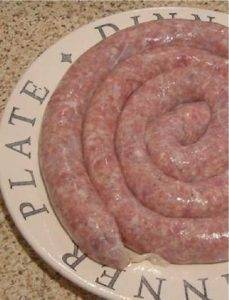
Once the sausages are made you may link them if you wish or leave it in a coil like Cumberland Sausage.
Place in the refrigerator over night for the flavour to develop this is called blooming by sausage makers.
Linking Sausage
Start with a length of sausage in the casing not too tightly packed.
I am right handed so you need to remember this while I try to explain how this is done.
With your left hand extended as if to shake some ones hand hang a length of sausage over to form a horse shoe, with your thumb press down onto you fore finger on your left hand (remember I am right handed), move this link to the bottom of your hand & make a horse shoe again.
You now have a link hanging below the palm of your hand with the rest of the sausage hanging over the back of your hand.
At the place where you squashed the link you press this against the piece of sausage hanging over your hand. Twist it around and remove the horse shoe from your hand, pass the link through the middle. That the first link made it won’t look like much but the first never does. Now let the three links you have just made hang below your hand (Palm side) and form a horse shoe over your hand, twist it with the top of the link you have made earlier slide this off and bring a piece of sausage up as if you were drawing a line through the horse shoe push a small amount of sausage through the horse shoe and where they cross press down with your finger & thumb. Now take one of the sides of the horse shoe and push it through between the centre link& the outer wall of the horse shoe you will need to twist this as you do it. If you have pushed sufficient through the horse shoe it should twist very easily, if it breaks then you have either overstuffed the casing or you need to push more through next time.
Now let the links you have just made hang down as before & repeat.
Remember practice makes perfect I promises you will soon get the hang of it.
The next day it’s over to you.
Cook them slowly in a frying pan or grill & enjoy.
How much casing do I need?
|
Sausage Size per lb |
Sausage Type |
Casing Type |
Inches per Sausage |
Approx Sausage Weight |
Approx Inches of Casing per pound including 10% for linkinfl |
Calibration of casing Required |
|
32 |
Cocktail |
Collager/Sheep |
2 |
O.5oz |
70,40 |
18-20 |
|
16 |
Chipolata |
Collagen/Sheep |
4 |
1oz |
70.40 |
18-2C |
|
12 |
Links |
Cullapen/Sheep |
4 |
1.3« |
52:80 |
23 |
|
10 |
Links |
Collagen/Sheep |
4 |
1.6oz |
44.00 |
26 |
|
8 |
Standard |
Collagen/Hog |
4 |
2cz |
35.20 |
28 |
|
4 |
Jumbo |
Collagen/Hog |
8 |
4cz |
35.20 |
28 |
|
5 |
Chippy |
CollapBu/Hog |
4.75 |
32oz |
26.13 |
28 |
|
a |
Trad Butcher |
Collagen/Hog |
4 |
2 Boz |
26,40 |
30-32 |
Texture
Texture is another question that seems to pop up now and again, the things that affect texture are:-
Water
Meat
Salt
Phosphate
Temperature
Mixing time
Mincing Just about everything really!
To take them one at a time
WATER
In essence the more water less texture or at least you would think, but not always as this can be used to form an emulsion with soya protein, if you make an emulsion with say cooked rinds, water & soya protein in the following amounts you can get an emulsion that gels hard enough to stand on 5kg water, 5kg Pork Rind (Cooked & Minced) 1Kg Soya protein
Also do not be tempted to make sausage without water, I know you will find people telling you to do so & you may even find recipes that are free from this, but as a general rule use it.
It is needed to penetrate the meat cells & carry in the salt; this in turn extracts myosin (The binding protein, much like gluten in bread) & helps the bind & gives texture of the sausage
MEAT
Meat it self will give a good texture but only if it is treat well.
Just think of frozen mince you buy in the supermarkets, when you brown this in the pan it is almost like dust. This is not because it’s cheap meat it is because it is minced from a frozen block of meat.
If you mince fresh meat you get a nice flow of meat fibres while mincing this in turn can then re-bind in cooking & processing, however if you freeze the meat solid then the fibres are in straight lines & the mincing head chops them in to tiny pieces (Humpty Dumpty syndrome). So chill you meat well but do not freeze just enough so it goes through the mincing head without the fat smearing or getting sticky.
SALT
Salt the most important ingredient this little beauty is not only flavour, it is responsible for texture & preserving.
To make the most of this it needs to be in solution so that it can enter the meat cells quickly & extract the protein.
PHOSPHATE
Whilst a lot of people will not use any of this unless you are buying pre made seasonings thought I would cover it with a few lines.
It is used to move the Ph of the meat so that if can absorb the water more quickly & therefore aid the texture.
Too much will give you a texture like rubber so use sparingly & only at the recipes recommended rate. It will also give a metallic taste if used to high.
TEMPERATURE
Temperature can be an enemy or a friend it really depends on you, if it is controlled then the later is true.
When making emulsified style sausage you need to chop the meats very hard up to a temperature of about 10c, then you must bring the temperature back down quickly, this is done by adding crushed ice to the mix after you have formed your emulsion.
Using temperature this way you can make some very good frankfurter sausages with a snap that could be heard in the next room.
MIXING TIME
Mixing time is really simple the longer you mix the tighter the texture will be, so if you want loose textured sausages then only mix until the water is absorbed & if you want a nice tight sausage mix a little longer.
I would suggest that you mix by hand to start with this way you will learn about absorption & texture together.
MINCING
The last one I will touch upon is mincing and again it is fairly simple the smaller you mince the tighter the sausage becomes, provided as said before that the meat is not frozen.
I always start of mincing through the largest plate available & then mix the meat, water, seasoning & rusk or bread crumb, before re mincing through a 5mm or smaller plate.
I like the texture this gives.
Sausage Types
There are far too many sausages to list as every country in the world has a vast array of sausage products & there are many books covering this area, including a lot of free recipes on the internet, I have listed the main ones here in the UK but even here there are literally thousands.
Pork
Traditional for all areas, & flavoured with just about anything you can think of, some have strong spices like paprika or cracked black pepper other have ginger, nutmeg, clove or herbs. Pork & Leek, Cumberland, Cambridge, Lincolnshire etc
Pork & Beef
Once the biggest selling sausage in the UK but fell out of favour due to BSE Oxford sausage is one of these types of sausage being made with Pork & veal
Beef
Traditionally from the highlands of Scotland & the Midland in the UK & mixed with pepper or tomato
Lamb
With Mint or Rosemary with Garlic, Red wine & Mustard
Chicken & Turkey
The perfect meats for those wanting a low fat type sausage